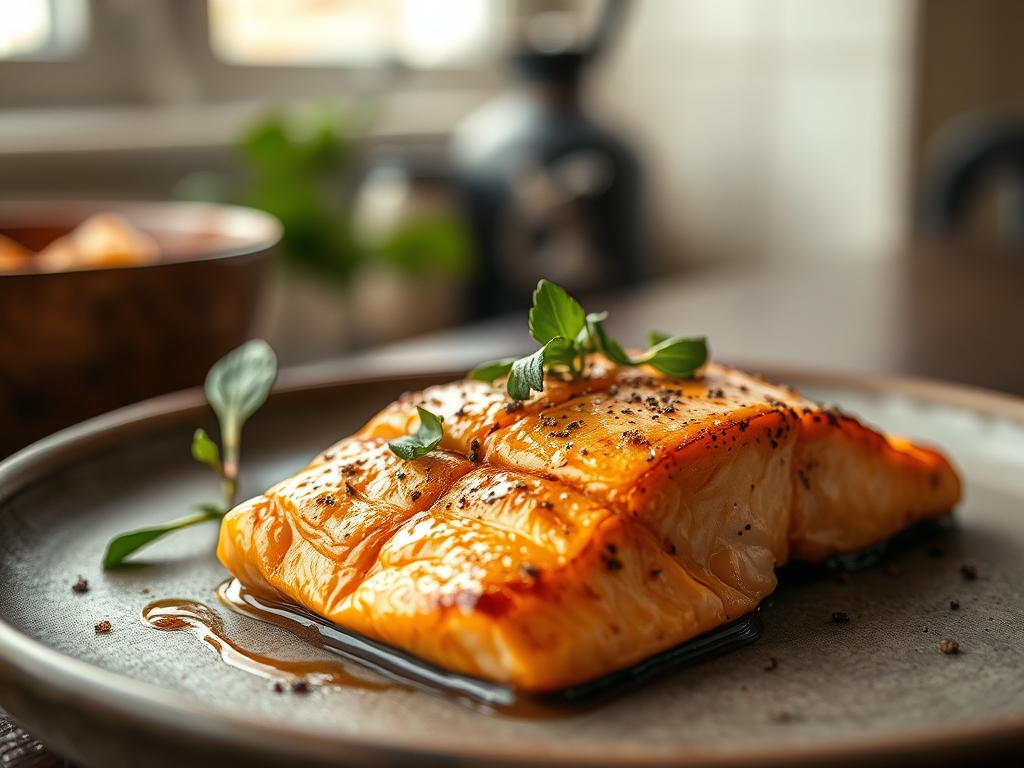
Imagine the sound of a cold, marble-grey fillet hitting a shimmering, heavy-bottomed stainless steel skillet. The hiss is immediate; it is the sound of moisture rapidly evaporating to make room for the golden, structural miracle of the Maillard reaction. Finding truly healthy delicious salmon recipes is not just about counting calories; it is about mastering the alchemy of high-quality fats and delicate proteins. We are moving past the days of dry, chalky fish. Today, we are focusing on the buttery, flake-apart texture that occurs when you treat a piece of fish with the same technical respect as a prime ribeye. Salmon is a nutritional powerhouse, packed with long-chain omega-3 fatty acids that support brain health and reduce systemic inflammation. By the end of this guide, you will understand the physics of heat transfer and the chemistry of acid-based marinades. We are going to transform your kitchen into a high-end bistro where the "catch of the day" is always executed with surgical precision and soulful flavor.
The Gathers:
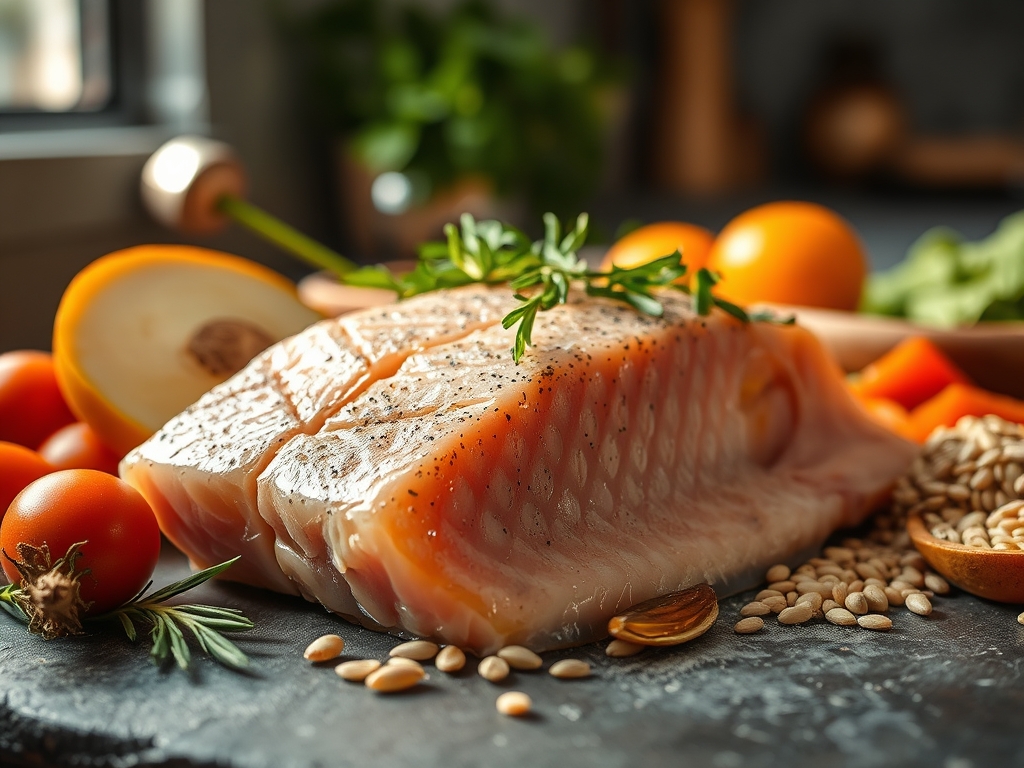
Setting up your mise-en-place is the difference between a panicked kitchen and a professional flow. Start with your centerpiece: wild-caught Coho or Sockeye salmon. Wild varieties possess a more robust, lean muscle structure compared to farmed Atlantic salmon, which has a higher lipid content and a more viscous mouthfeel. You will need a high-smoke-point oil, such as avocado or refined grapeseed oil, to ensure you do not reach the "acrolein point" where fats break down and turn bitter.
For the aromatic profile, gather fresh dill, flat-leaf parsley, and a bulb of garlic. Use a microplane to zest two lemons; the essential oils trapped in the flavedo (the yellow outer skin) provide a piquant brightness that juice alone cannot replicate. You will also need kosher salt for its jagged crystal structure, which adheres better to the flesh than fine table salt.
Smart Substitutions: If you are watching your sodium, swap traditional soy sauce for coconut aminos to maintain that deep umami profile without the salt spike. For a dairy-free "cream" sauce, use full-fat coconut milk aerated with a splash of apple cider vinegar to mimic the lactic tang of creme fraiche. Always use a digital scale to measure your portions; 150 grams is the "Goldilocks" zone for a single serving that cooks evenly through the center.
The Clock:
Efficiency in the kitchen relies on "Chef's Flow," the art of overlapping tasks so no heat is wasted. Your total preparation time is approximately 15 minutes, which includes the time needed for the fish to temper on the counter. Never cook fish straight from the refrigerator; the extreme temperature delta causes the muscle fibers to seize and expel albumin (that unsightly white protein).
The actual cook time is a tight 8 to 12 minutes depending on thickness. We allocate 6 minutes for the initial sear to establish a structural crust, followed by a 2 to 4 minute finish on the reverse side or under a broiler. Finally, a 5 minute rest is mandatory. This allows for thermal carryover, where the internal temperature rises by 5 degrees off the heat, ensuring the center reaches a perfect 125 degrees Fahrenheit for a medium-rare finish.
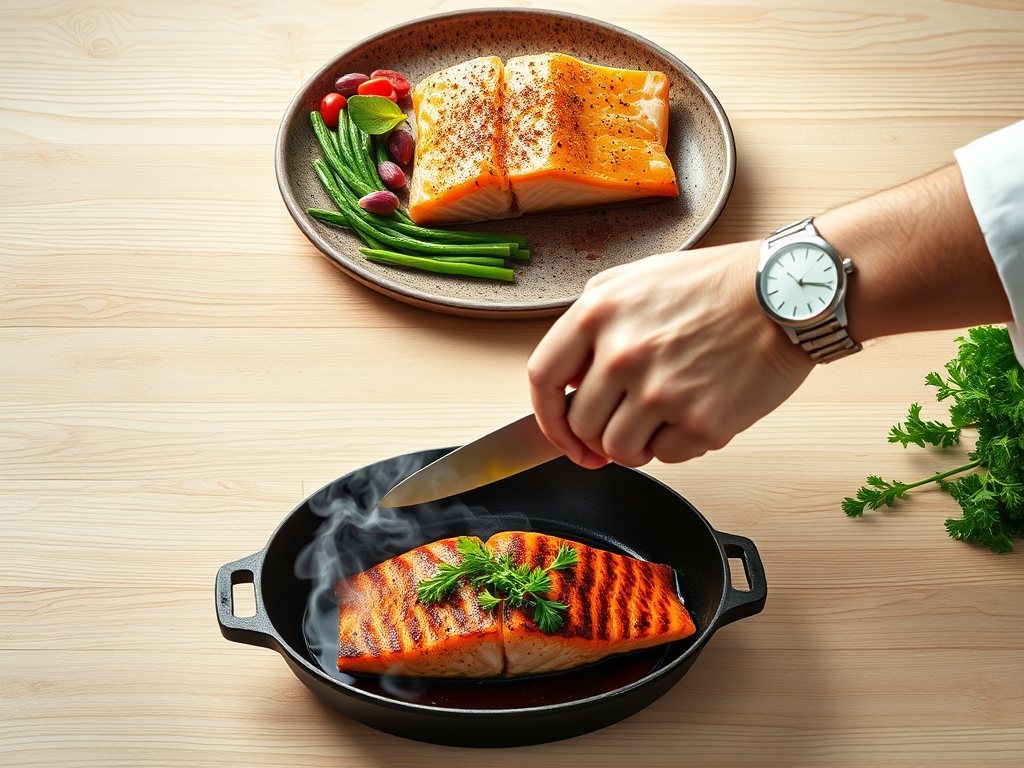
The Masterclass:
1. The Desiccation Ritual
Use a lint-free paper towel to pat the skin bone-dry. Moisture is the enemy of the sear; if the surface is damp, the fish will steam rather than fry.
Pro Tip: This prevents the "Leidenfrost effect," where a layer of steam lifts the fish off the pan, preventing the direct contact necessary for enzymatic browning.
2. The Precision Seasoning
Season from a height of six inches to ensure even distribution of salt and cracked black pepper. Do this only seconds before the fish hits the pan to prevent the salt from drawing out internal moisture via osmosis.
Pro Tip: Salt acts as a denaturant, partially breaking down protein strands so they can cross-link and form a crispier surface during the sear.
3. The Cold-Pan Press
Place the salmon skin-side down in a preheated heavy-bottomed skillet. Use a flexible fish spatula to press down firmly for the first 30 seconds.
Pro Tip: Fish skin contains collagen that shrinks when it hits heat. Pressing it flat ensures the skin stays in contact with the pan, resulting in a glass-like crunch rather than a rubbery texture.
4. The Aromatics Infusion
Once the skin is crisp, toss in smashed garlic cloves and a sprig of thyme. Tilt the pan and use a spoon to baste the hot, flavored oil over the flesh.
Pro Tip: This is known as "Arrosé." The hot fat gently cooks the top of the fillet while infusing the delicate fats with fat-soluble aromatic compounds.
5. The Gentle Flip
Using tongs and a spatula, gently roll the fish onto its side. Turn the heat down to medium-low to finish the interior without scorching the exterior.
Pro Tip: Lowering the heat prevents the rapid contraction of muscle fibers, which keeps the natural juices trapped inside the cellular walls.
6. The Deglaze and Emulsify
Remove the fish and add a splash of white wine or vegetable stock to the pan. Use a bench scraper or whisk to pick up the "fond" (the brown bits).
Pro Tip: This process, called deglazing, captures the concentrated flavors of the Maillard reaction. Whisking in a teaspoon of cold butter or tahini creates a stable emulsion for a silk-smooth sauce.
The Deep Dive:
When we look at the macro nutrition of these healthy delicious salmon recipes, we are seeing a near-perfect profile: roughly 25 grams of protein and 12 grams of healthy fats per serving. It is a ketogenic dream and naturally gluten-free. For a vegan swap, you can apply these same searing techniques to "steaks" of cauliflower or extra-firm tofu, though you will need to add a dash of liquid smoke to mimic the salmon's natural depth.
The Fix-It: Troubleshooting Common Failures
- The White Gunk: If you see white clouds (albumin) leaking out, your heat is too high. Fix it by immediately pulling the pan off the burner and letting the residual heat finish the job.
- The Stick: If the fish feels "glued" to the pan, do not force it. The fish will naturally release itself from the metal once the skin has fully carbonized and dehydrated.
- The Sog: If your skin is flabby, you likely crowded the pan. Cook in batches to ensure the steam can escape the vessel.
Meal Prep and Reheating Science:
To maintain "day-one" quality, never reheat salmon in a microwave; the radiation vibrates water molecules so violently it toughens the protein. Instead, use a "low and slow" method in a toaster oven at 275 degrees Fahrenheit with a teaspoon of water covered by foil. This creates a mini-steamer that rehydrates the lipids without overcooking the core.
The Wrap-Up:
Mastering healthy delicious salmon recipes is your gateway to becoming a more intuitive, confident cook. You now have the technical vocabulary to understand why your food behaves the way it does under pressure. From the initial desiccation of the skin to the final emulsion of a pan sauce, every step is a deliberate move toward culinary excellence. Go grab your saucier, find the freshest wild-caught fillet you can, and let the science of flavor take over your kitchen. You have the tools; now go make some magic!
The Kitchen Table:
How do I know when the salmon is perfectly cooked?
The most reliable method is using a digital thermometer to find an internal temperature of 125°F for medium-rare. Visually, the flakes should just begin to separate when pressed gently with a fork, showing a translucent center.
Why does my salmon always stick to the stainless steel pan?
Sticking usually happens because the pan wasn't hot enough or the fish was too damp. Ensure the oil is shimmering and wait for the "natural release," where the seared crust detaches itself from the metal surface once fully formed.
Can I use frozen salmon for these recipes?
Yes, but thaw it slowly in the refrigerator for 24 hours. Once thawed, it is vital to pat it extremely dry, as frozen fish tends to release more exterior moisture which can impede a proper Maillard sear.
Is the skin actually healthy to eat?
Absolutely. The skin contains the highest concentration of omega-3 fatty acids. When seared correctly using the "press technique," it becomes a crispy, flavorful cracker that provides a necessary textural contrast to the soft, buttery flesh of the fish.